Context, not just transcription.
Where aiomics fits into your existing landscape
Many hospitals already use speech recognition solutions — for in-conversation documentation, dictation, or transcription. These tools solve a real problem: they speed up text creation.
What they do not solve: context. When a discharge letter draft is based on a conversation but does not incorporate prior reports, lab values, and referral letters, the foundation is missing. The conversation becomes the next information silo.
aiomics complements existing solutions rather than replacing them. The platform reads all available documents — regardless of format and source —, structures the content, and reconciles it systematically. The results serve as context for every subsequent step: for reporting, applications, forms, and coding.
Where your hospital already has a solution in place, we create no duplicate structures. Where gaps exist, we fill them.
Why reconciliation matters more than generation
Most AI systems in clinical documentation trust your documents blindly. They read what is there and generate text from it. The result looks convincing — but the better an AI-generated text is formulated, the harder it is to recognize that its foundation was incomplete.
aiomics works differently. Our multi-stage reconciliation process Integros assumes that existing documents may contain gaps and inconsistencies — and reconciles them against each other before anything is generated.
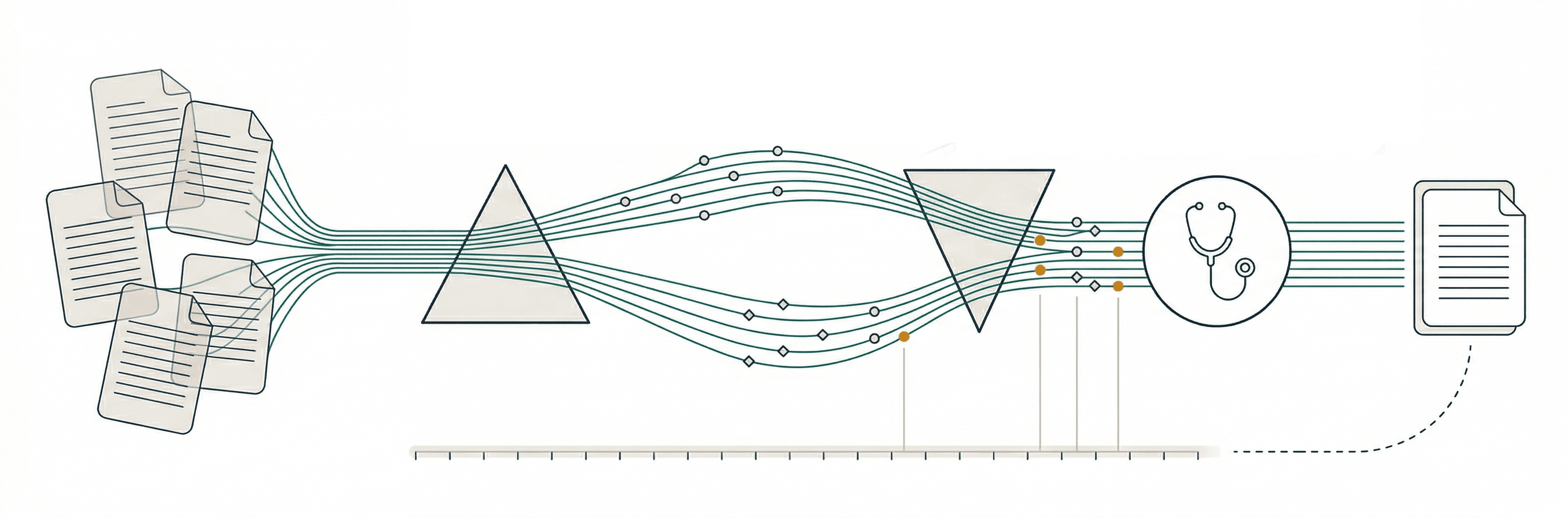
Two independent analysis agents
Two AI agents process the same source documents independently. Each creates its own structured summary.
Systematic cross-reconciliation
A third agent compares both summaries specifically for discrepancies and missing information.
Synthesis
A fourth agent evaluates the discrepancies found, creates the final structured overview, and clearly marks where source documents diverge.
Source references
Every piece of information in the overview is linked to the original document. One click shows you the source.
The principle mirrors the peer review process in scientific publishing: independent reviewers assess the same subject matter, an editor consolidates the findings, and the original data remains accessible at all times. Except the process takes seconds instead of months — and applies to every single patient record.
Integros creates administrative overviews based on existing documents. No clinical assessment or diagnosis.
Modules in Detail
Admission Management — Admit the right patients quickly and reliably
Admission management displays all pending referrals and planned admissions on a Kanban board. aiomics reads incoming documents, structures relevant information, and flags missing documents. Eligibility assessment becomes faster, documentation is complete from the start.
Faster responses to suitable referrals. Less effort for unsuitable ones. Complete admission documentation before the payer asks.
Patient Overview — Know in minutes what takes hours of chart review today
Betaaiomics creates a chronological, structured overview based on all available documents. Diagnoses, medication, findings, allergies, and lab values are extracted and reconciled. Where documents diverge, it becomes visible — with direct access to the originals.
You see in minutes what is in which document, what is missing, and where sources disagree. The chart review stays with you — but the groundwork is done.
Data overview — no clinical assessment. Source documents accessible via the document icon.
Reports and Letters — From back-and-forth to finished draft
aiomics generates source-based report drafts directly from the patient overview. Structure and formatting follow your templates. Each section is linked to the original source. Revision effort decreases — because the foundation is more complete than what someone assembles from memory or the HIS.
Fewer revision cycles. Faster completion. Discharge letters within days — not weeks.
AI draft — physician review and approval required.
Revenue Protection — Good documentation starts before day one
aiomics ensures that documentation-relevant information is captured in a structured way before and during treatment — not only at the discharge letter or coding stage. The platform drafts payer communications and applications based on available documentation, with source references.
Documentation that is traceable from the start. Less retroactive assembly. Fewer follow-up questions. More trust from the payer.
Coding suggestions based on documentation — no billing advice. All suggestions require physician review.
Forms and Applications — 10 minutes of typing that no human should still be doing
Betaaiomics generates suggested form content based on the patient overview. Before submission, missing required fields are flagged. When the payer follows up, relevant source information is already structured and ready.
Less typing. Fewer errors. And when the follow-up question comes, the answer is prepared.
Completeness hints — no medical recommendations.
Pragmatic, not theoretical
We know what reality looks like. Interoperability has been a big promise in European healthcare for years — and in practice, integration often means five-figure investments and 18 months of delay before a project can even start.
That is why we built aiomics to work without deep system integration. The platform runs in the browser. No installation. No maintenance. No upgrade tasks for your IT department. Essentially, you just need to inform your IT that they do not need to do anything.
Where integration makes sense — such as lab connections, fax reception, or importing from existing systems — we actively offer it and take on a generous share of the integration work. We support HL7v2, FHIR R4, and ISiK.
And for everything else, there are pragmatic interim solutions: document upload, scan connection, folder monitoring. Fast, straightforward, without dependency on complex interface projects.
Want to see how aiomics works with your documents?
Explore the PlatformNo-obligation demonstration — with your own documents if you like.